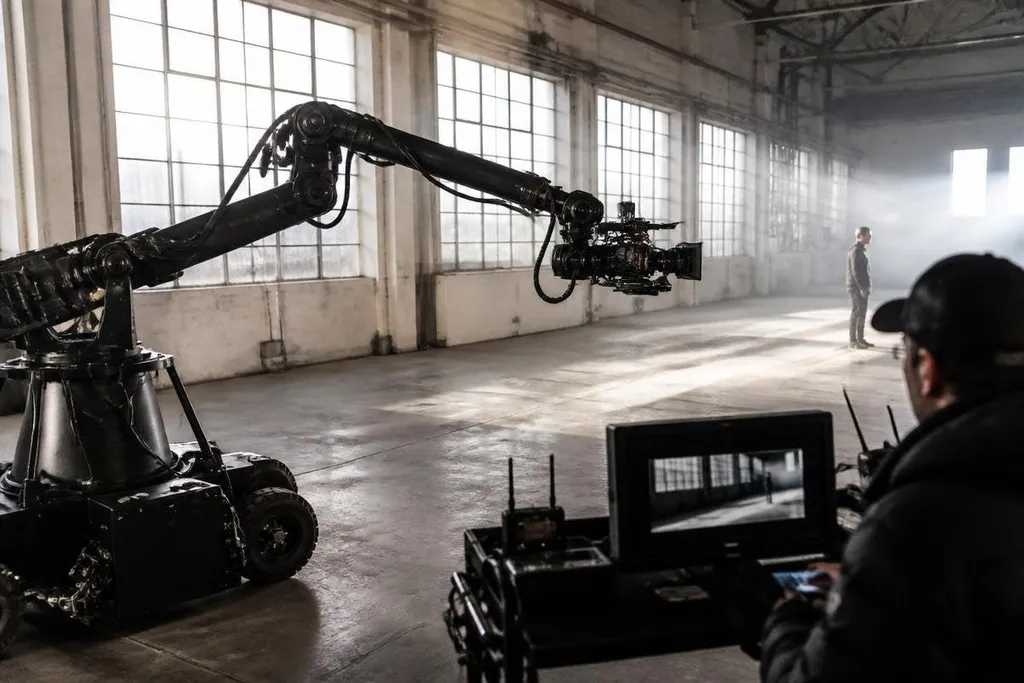
A film robot has one job that matters on set: repeat the same camera move when the scene changes. The next stage of this work will depend on safer control, better set data, and clear limits rather than human-shaped machines.
- Robotic camera arms can repeat programmed paths across takes.
- Remote control lets a crew member stay away from moving hardware.
- The hard problems are safety, setup time, and changes on set.
What film robots do well
A robotic camera arm moves a camera through a planned path. Operators can set its speed, position, lens direction, and timing, then run the move again when the actors need another take.
That repeatability matters when a scene includes visual effects, lighting changes, or several camera angles. A human operator can repeat a move by hand, but small changes in speed and position can make matching shots harder.
The arm also gives the camera access to paths that would need a track, crane, or large crew setup. Its usefulness depends on the camera weight, the arm’s reach, the available floor space, and the time needed to check the path before filming.
Film robots can also support motion-control work, where the system follows recorded movement with a high level of timing control. This is useful when a production needs the camera and a physical object to move together across several takes.
The next step is better set awareness
Programmed movement works best when the set stays fixed. Film sets rarely do. A light may move, a prop may change position, or a person may enter the camera path.
Future systems will need better ways to read the space before each move. Cameras, distance sensors, and marked safety zones can help the control system check whether the planned path is still clear.
The production team must still approve the move, because a sensor can miss a loose cable, a soft prop, or a person outside its viewing angle.
Remote operation will remain useful. A technician can control the arm from a safe position while watching the camera feed and the robot’s motion. That setup also gives the crew a clear stop point when the scene changes.
That human stop point matters beyond a film set. Robot24 reports on robots where control, sensing, and safety rules meet physical work, giving you a wider reference for judging a film arm. The open question is whether that proof holds when a crew changes the shot, the tool, or the distance from people.
Where the limits remain
A robot arm cannot decide what makes a shot useful. The director, camera operator, and gaffer still set the visual goal. The robot follows a move after people choose the framing, speed, and timing.
Setup can also take longer than the finished shot suggests. The production team needs to place the arm, mount the camera, check the full path, set limits, and confirm that the robot will stop in the right place if someone enters the work area.
Weight creates another limit. A larger camera package needs a larger arm, a stronger base, or a slower move. That extra hardware takes floor space and may change how the crew works around the actors.
Autonomous movement brings a separate concern. A system that changes its path on its own may save operator input, but the crew must still know why it changed and how to stop it. For a film set, a clear and repeatable control system may be more useful than a system that makes its own choices.
A practical checklist for productions
Before renting or buying a film robot, check these points:
- Camera load: Match the full camera, lens, focus motor, and cable weight to the arm’s rated payload.
- Move repeatability: Ask for a recorded path and a stated position error across repeated takes.
- Set changes: Check how the system handles a blocked path, a moved prop, or a person inside the work zone.
- Operator control: Confirm who can start, pause, and stop the move during filming.
- Setup time: Measure the time from the arm arriving on set to the first approved take.
- Crew training: Confirm which team members can program the arm and recover from a stopped move.
These checks turn a broad promise into a production decision. A robot that repeats a shot well but takes too long to place may fit a visual-effects stage and fail on a fast location shoot.
The useful future for film robots is clear enough to test: repeat the camera move, keep people safe, and fit the crew’s working day. I’d choose a system with proven control and fast setup before one that tries to act like a person.